Deep Cartograph

Deep Cartograph is a package to analyze and enhance molecular dynamics (MD) simulations. It trains collective variables (CVs) from simulation data, either to analyze existing trajectories or to enhance sampling in subsequent simulations. It uses PLUMED to compute features and the mlcolvar library to train the CVs. Developed for the European BioExcel project, funded by the European Commission (EU Horizon Europe 101093290).
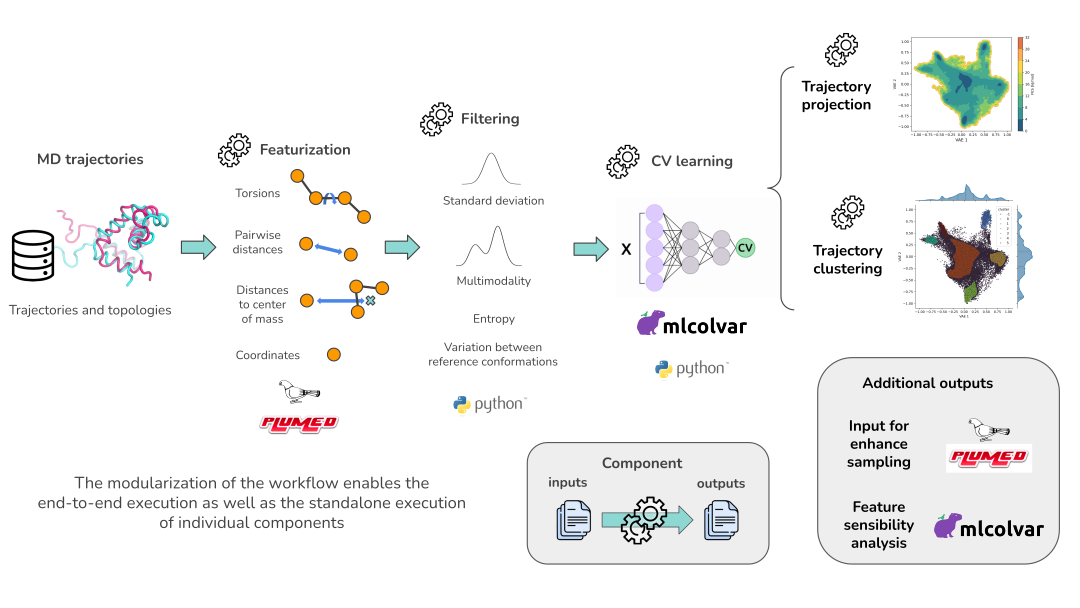
Starting from trajectory and topology files, Deep Cartograph can:
Featurize the trajectory.
Filter the features.
Compute and train different collective variables.
Project and cluster the trajectory in the CV space.
Produce a PLUMED input file to enhance the sampling.
New here? Start with the Installation guide, skim the
Concepts page if terms like collective variable or colvars file are new to you,
then run the full deep_carto workflow.
Workflow
Command |
Purpose |
|---|---|
Run every step, from featurization to clustering, in one command. |
Tools
Each step is also available as a standalone command and as a Python function.
Command |
Purpose |
|---|---|
Align trajectories to a reference topology. |
|
Simple geometry analysis: RMSD, RMSF and dRMSD. |
|
Augment trajectory samples by interpolating between frames. |
|
Compute features from a trajectory using PLUMED. |
|
Keep the most informative features. |
|
Train collective variables with mlcolvar. |
|
Project trajectories onto pre-trained CVs. |
|
Cluster trajectory frames in the CV space. |
Citing
If you use Deep Cartograph, please cite it using the metadata in the
CITATION.cff file
(GitHub’s “Cite this repository” button generates APA and BibTeX entries from it).


Licensing
Offered under a dual-license model: free for academic and non-commercial use under
CC BY-NC-SA 4.0; a separate commercial license is required for for-profit use
(contact it@nostrumbiodiscovery.com). See the LICENSE file in the repository.